
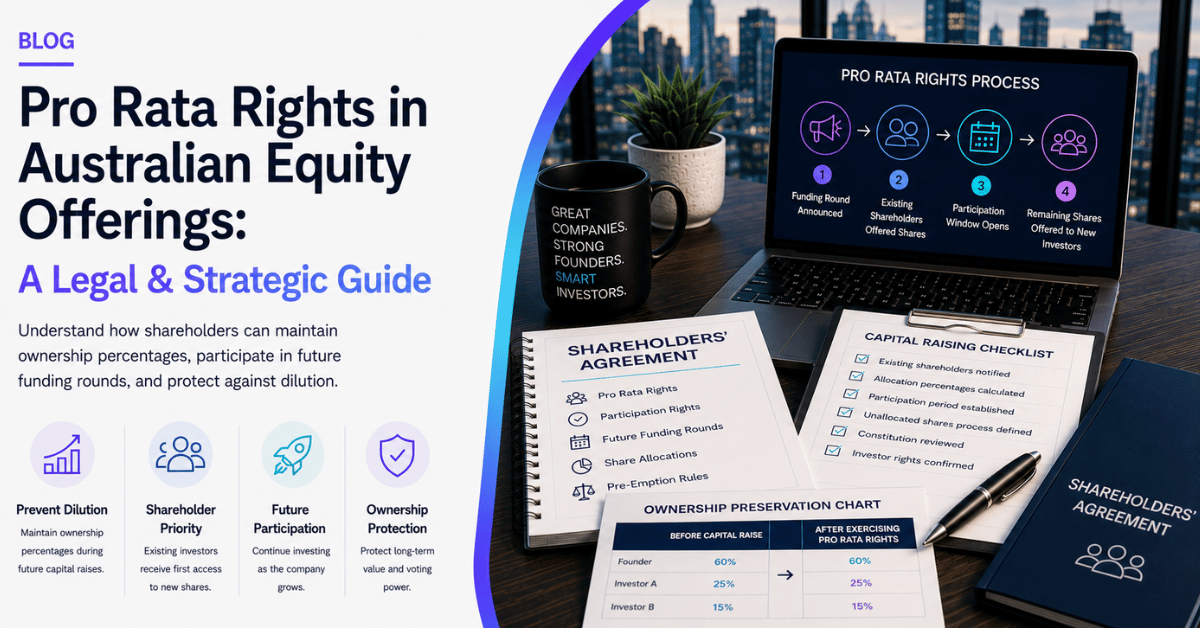
Pro rata rights are a key protection in Australian equity offerings.
They let existing shareholders buy new shares in proportion to their existing holdings before those shares are offered to others.
This is particularly important for growing private companies raising capital. Founders and early investors often use these rights to protect their ownership percentage as new investors come on board.
This guide explains how pro rata rights work, the legal framework behind them, and key tax considerations before your next capital raise.
What Are Pro Rata Rights?
Pro rata rights, also known as pre-emptive rights, give existing shareholders the first opportunity to buy new shares. They can purchase shares in proportion to their current holding before the company offers them to new investors.
They exist for three main reasons.
- Protection from dilution: Without pro rata rights, a shareholder’s ownership percentage can decrease when the company issues new shares. This can happen even if the shareholder has done nothing wrong.
- Faster capital raising: turning to existing shareholders first is often quicker than negotiating with brand new investors.
- Fair treatment: offering new shares to current shareholders first, before outsiders, treats everyone already invested fairly.
How Pro Rata Rights Work for Private Companies
Most Australian startups are proprietary (private) companies, not listed on the ASX. For these companies, pro rata rights usually work differently to a listed company’s public rights issue.
Under the Corporations Act, proprietary companies are subject to a default pre-emption rule. New shares of a class must first be offered to existing shareholders of that class in proportion to their holdings. This is a replaceable rule. A company’s constitution can modify or remove it. Shareholders can also agree to waive it for a specific capital raise.
In practice, most funding rounds handle pro rata rights through the shareholders agreement rather than relying on the default rule alone. Investors, especially venture capital funds, often negotiate specific pro rata or participation rights as part of their investment terms, giving them the right to invest in future rounds to maintain their percentage ownership.
The Legal Framework for Pro Rata Rights
Several parts of the Corporations Act 2001 (Cth) are relevant.
- Section 254D sets the default pre-emption rule for proprietary companies described above, offering new shares of a class to existing shareholders of that class first.
- Section 708AA allows a rights issue to proceed without a full disclosure document in certain circumstances, which keeps a capital raise faster and less costly.
- Section 256B covers reductions of share capital, a separate process to be aware of if a raise is later followed by any capital restructuring.
ASIC also provides guidance on disclosure relief for rights issues, setting out the conditions companies need to meet to rely on the streamlined disclosure exemption.
Tax Implications for Investors and Companies
For investors, shares acquired through a pro rata rights issue are added to their Capital Gains Tax cost base at the price paid. If a shareholder later sells their right rather than exercising it, CGT can apply to those proceeds too.
For companies, costs associated with running a rights issue, such as legal and advisory fees, are generally treated as capital in nature under the Income Tax Assessment Act 1997 (Cth), rather than as an immediate tax deduction.
If the company later pays dividends, it needs enough franking credits available to avoid an unwelcome tax outcome for shareholders, though this is less of a live issue for early-stage companies not yet paying dividends.
Getting Pro Rata Rights Right in Your Shareholders Agreement
For a private company, the details that matter most sit in the shareholders agreement, not just the Corporations Act default rule.
- Clear timeframes: set out exactly how long shareholders have to exercise their pro rata right before it lapses.
- Treatment of non-participants: decide upfront what happens to the unallocated portion if some shareholders do not take up their right.
- Interaction with other rounds: make sure pro rata rights sit consistently alongside any convertible notes, SAFEs or option pools already on the cap table.
- Constitution alignment: check whether the company’s constitution already modifies or removes the default rule under section 254D, so the shareholders agreement and constitution do not contradict each other.
Getting this documented properly before a raise avoids disputes about who was entitled to what, once new investors are at the table.
Pro Rata Rights vs Anti-Dilution Protection
These two terms often get confused, but they solve different problems. Pro rata rights give a shareholder the option to buy more shares to keep their percentage steady. Anti-dilution protection is a separate mechanism, usually only available to preferred shareholders, that adjusts their existing shares or conversion price if the company later raises money at a lower valuation. A shareholder can have one, both, or neither, depending on what was negotiated at the time they invested.
Frequently Asked Questions
1. What are pro rata rights?
Pro rata rights give existing shareholders the opportunity to buy new shares in proportion to their current holdings before the company offers those shares to new investors. These rights help shareholders maintain their ownership percentage and avoid dilution.
2. Do private companies in Australia have to offer pro rata rights?
Section 254D of the Corporations Act gives existing shareholders in a proprietary company the first opportunity to purchase new shares of their class before the company offers them to others. However, a company’s constitution or shareholder agreement can modify or remove this default rule.
3. How are pro rata rights different for a startup compared to an ASX-listed company?
Listed companies run formal rights issues under ASX Listing Rules, often with renounceable rights that trade on the ASX. Private companies more commonly handle pro rata rights through the shareholders agreement and individually negotiated investor participation rights, rather than a public market process.
4. Do pro rata rights have tax implications?
Yes. Shares acquired through a pro rata rights issue form part of the investor’s CGT cost base. Companies generally cannot deduct the costs of running a rights issue, as these are treated as capital expenses.
5. What should a startup include in its shareholders agreement about pro rata rights?
Clear exercise timeframes, what happens to any unallocated shares if some shareholders do not participate, and how the pro rata rights interact with convertible notes, SAFEs or existing option pools.
Related Reading:
- Understanding Shareholder Dilution
- Allied Legal’s Comprehensive Guide to Shareholders Agreements
- Financing Your Start-Up Using Convertible Notes
Useful Resources:
Contact Allied Legal to structure your next capital raise: (03) 8691 3111 or hello@alliedlegal.com.au.
This article is provided for general information only and does not constitute legal advice. You should obtain legal advice specific to your circumstances before acting on any information contained in this article.