
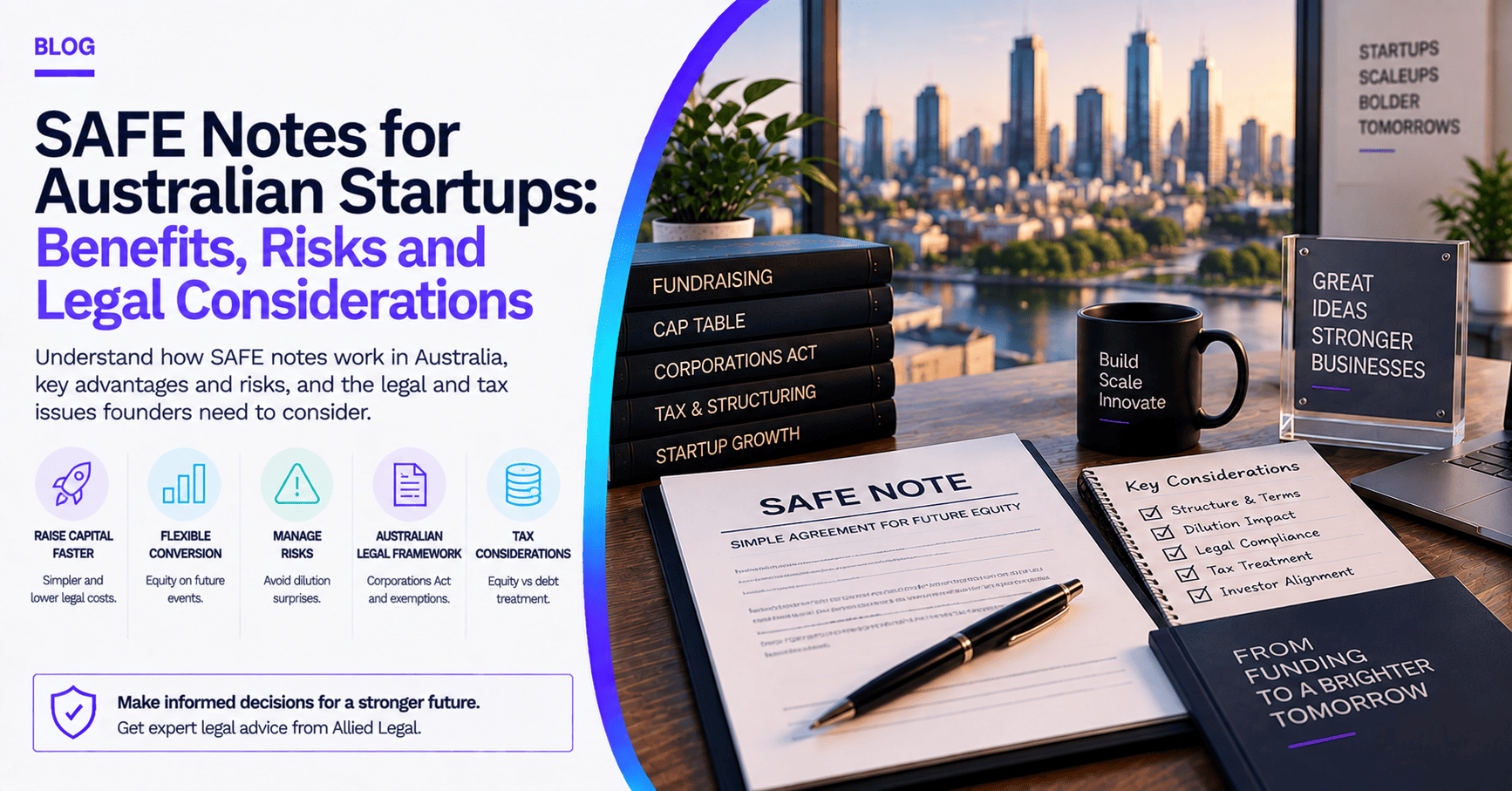
Simple Agreements for Future Equity, or SAFE notes, have become a common way for early-stage Australian startups to raise their first capital. Y Combinator introduced the SAFE in December 2013 as a faster alternative to convertible notes. It has since spread well beyond Silicon Valley. If you want the full mechanics of how a SAFE converts to equity, our guide to what a SAFE note is covers that in detail. This article focuses on something different. It looks at the benefits, risks, and Australian-specific legal and tax considerations founders need to weigh before using one.
How Australian SAFEs Differ From the US Original
The Australian market has not adopted a single standard SAFE template. This differs from the US market, which largely uses Y Combinator’s version. The Australian Investment Council publishes a template, but many SAFEs here are customised. Each one needs individual legal review rather than an assumption that all SAFEs work the same way. Australian practice has also shifted toward post-money SAFEs. These fix an investor’s ownership percentage at the time of investment, calculated against the company’s capitalisation including all outstanding SAFEs and convertible instruments. This protects early investors from dilution by later SAFEs. It can also compound founder dilution when several instruments stack up before a priced round.
Benefits of Using SAFE Notes
SAFE notes are simpler than a full equity round or a convertible note. This generally means lower legal costs and faster negotiations. They convert to equity on specific triggering events, such as a future funding round. This gives both sides flexibility around valuing the business early on. Founders can delay equity dilution during the earliest, riskiest stage of the business. They can still access capital quickly when it matters most for growth.
Risks and Disadvantages to Weigh
The lack of a fixed valuation at the outset can create mismatched expectations once conversion actually happens. SAFE notes typically pay no interest. This can make them less attractive to investors who want some return before conversion. Investors also carry a risk. They may end up with a smaller equity stake than expected if the startup’s valuation rises sharply before conversion. On the founder side, a few mistakes come up often. These include issuing multiple SAFEs without modelling their cumulative dilution, using an unmodified US template that does not fit Australian corporate law, and signing without legal review of the conversion mechanics.
Legal Considerations Under Australian Law
A SAFE will likely count as a security under the Corporations Act 2001 (Cth). This can trigger Chapter 6D disclosure obligations unless an exemption applies. Two exemptions cover most early raises. The small-scale offering exemption allows up to 2 million dollars from no more than 20 investors in any 12 month period. The sophisticated investor exemption applies to investors who meet asset or income thresholds. Founders also need to check their company’s constitution actually authorises issuing a SAFE on the proposed terms. Converting into a new share class can require shareholder approval by special resolution, and this is easy to miss until conversion is already underway.
Tax Treatment of SAFE Notes
A standard SAFE has no maturity date, no interest, and no repayment obligation. This kind of SAFE is generally treated as an equity interest under Division 974 of the Income Tax Assessment Act 1997 (Cth). The company cannot claim a tax deduction for amounts received under it. Investor returns are generally taxed under the capital gains tax rules once the SAFE converts to shares. This equity classification is also why standard SAFEs tend to qualify more easily than convertible notes for venture capital tax concessions. Notes with a redemption right at maturity often fail that test. Adding a maturity date, interest, or a repayment obligation to a SAFE can shift its tax classification toward debt. This changes the tax outcome for both the company and the investor, and it can affect eligibility for venture capital concessions. Get this checked before you customise a template.
Best Practices to Manage These Risks
Clear communication about the SAFE’s terms from the outset avoids most disputes down the track. Regular updates to investors about progress and likely conversion events keep the relationship on solid footing. Model your cumulative dilution across every SAFE and convertible instrument you plan to issue, not just the one in front of you. This shows you what your cap table looks like after a priced round. Get legal advice before you adapt a US-style template, to make sure it actually works under Australian law.
SAFE Notes Compared to Other Funding Options
SAFE notes are not the only early-stage funding instrument available, and they are not always the right one. If you are deciding between a SAFE and a convertible note for your raise, our comparison of SAFEs and convertible notes sets out the practical differences. Getting your cap table and founder vesting arrangements right alongside any SAFE issuance also matters. These instruments interact directly with how much of the business founders retain over time.
Frequently Asked Questions
1. Is a SAFE note debt or equity in Australia?
A standard SAFE has no maturity date, interest, or repayment obligation. This kind is generally treated as an equity interest under Division 974 of the Income Tax Assessment Act 1997. Adding any of those features can shift it toward debt.
2. Do SAFE notes need to be disclosed under the Corporations Act?
A SAFE will likely count as a security, which can trigger disclosure obligations unless an exemption applies. The small-scale offering exemption and the sophisticated investor exemption cover most early-stage raises.
3. Is the Australian SAFE the same as the US Y Combinator SAFE?
No. Australia has no single standard template. The market has also shifted toward post-money SAFEs, rather than the pre-money structure common in the original US version, so each SAFE needs individual review.
4. Can a SAFE affect my company’s venture capital tax concession eligibility?
Yes. Standard SAFEs tend to qualify more easily than convertible notes because of their equity classification. Any change that shifts a SAFE toward debt can affect that eligibility.
5. Should I use a SAFE note or a convertible note?
It depends on your raise, your investors, and how you want the instrument taxed. Our comparison of SAFEs and convertible notes sets out the practical differences to help you decide.
6. What is the biggest mistake founders make with SAFE notes?
Issuing multiple SAFEs without modelling their combined effect on the cap table. This can lead to far more founder dilution than expected once everything converts at a priced round.
How Allied Legal Can Help
Getting a SAFE note right in Australia means more than adapting a template you found online. Our team at Allied Legal reviews and drafts SAFE notes to fit Australian corporate and tax law. We check your disclosure exemption position before you raise, and model dilution across your cap table so you know what a raise actually costs you in equity terms. We also advise on whether a SAFE or a convertible note better suits your specific raise. Contact us at 03 8691 3111 or email hello@alliedlegal.com.au to discuss your next raise.
This article is provided for general information only and does not constitute legal advice. You should obtain legal advice specific to your circumstances before acting on any information contained in this article.